
Every legal team starts with templates. You draft a solid Master Service Agreement, save it as a Word file, and share it with the team. It works. The next deal goes out faster. You add a few variations for enterprise clients, SMBs, or a new product line, and suddenly you have a small library of documents that represent months of careful legal work.
For a while, this system holds up. But there is a structural problem baked into it that tends to surface slowly, and then all at once.
The Maintenance Problem
A contract template is, at its core, a static document. The legal logic, including your clauses, terms, and fallback positions, is embedded directly inside the file itself. That works fine when you have one or two templates. It becomes a real operational problem as your product offerings grow.
Consider what happens when your legal team needs to update a standard clause. Say regulations change and you need to revise your data processing terms. That update needs to propagate across every template in your library: the enterprise version, the SMB version, the APAC version, the version for each product line. Every file has to be opened, edited, saved, and redistributed manually.
"Miss one file, and an outdated term is quietly circulating in live contracts, potentially for months before anyone notices."
This isn't a hypothetical. It's the natural consequence of tying your legal logic to individual documents rather than managing it centrally. As your business scales, the number of templates scales with it, increasing the maintenance overhead scales too.
The Proliferation Problem
Templates also tend to multiply beyond what any single team can govern. A new region requires localised language. A new pricing tier needs different SLA terms. A partnership deal needs a modified liability clause. Each variation becomes its own file, often created by copying an existing template and making edits directly to it.
Over time, you end up with dozens of documents that share 80% of the same content but diverge in ways that are difficult to track. There is rarely a reliable way to know which version a given team member is using, or whether the template they pulled from a shared drive has been updated since the last policy review.
Templates are decentralised by nature. Each copy passed from person to person is a potentially diverged version of the original. Without a central source of truth for your legal logic, governance becomes a manual, error-prone process.
This is not a criticism of any particular tool. It is an inherent characteristic of document-based contract management at scale.
A Different Approach: Logic-Based Assembly
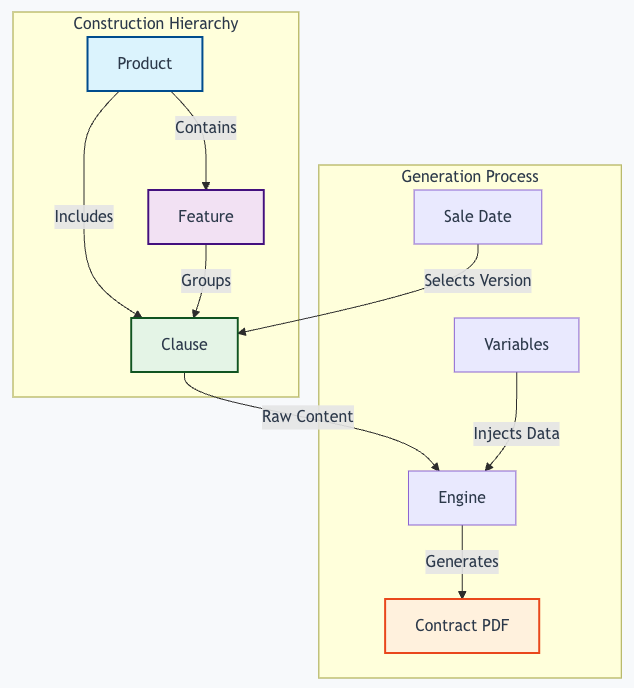
The alternative is to separate your legal logic from the document itself. Instead of maintaining a library of standalone files, you manage individual clauses in a central repository. When a contract is generated, the relevant clauses are assembled dynamically based on the deal type, product, region, and specific terms.
This changes the maintenance equation entirely. When a clause needs to be updated, you update it once, and that update flows through every contract that uses it, automatically. There is no library of files to synchronise. There is no risk of an outdated version circulating in the field.
It also makes compliance far easier to enforce. Because clauses are versioned centrally, you can see exactly which version of a term was active on any given sale date. If a contract was generated before a policy update, that is visible and auditable. If a contract was generated after, it reflects the new terms. The system handles this automatically, without relying on individuals to pull the right file at the right time.
What This Looks Like in Practice
Kollengo is built around this model. Contracts are constructed from a three-tier hierarchy of Products, Features, and Clauses. Your legal team manages clauses individually by versioning them, scheduling updates for future effective dates, and assigning approval requirements at the clause level for sensitive terms.
When a sales team member generates a contract, they select the relevant product, toggle the applicable features, and fill in deal-specific variables. The engine assembles the correct clauses, injects the data, and produces a final document. The legal logic governing that output lives in one place, maintained by the people responsible for it.
The goal is not to replace the careful legal thinking that goes into your templates. It is to give that thinking a more durable home that scales with your business instead of against it.